Why Four Different Sites Will Give You Four Different Harrisburg Home Prices
August 13, 2026
August 13, 2026
"They say the more rooftops you have, the more businesses look at you." Harrisburg Mayor Derick Wenck said that to KELOLAND not long after the town's population crossed 10,000 and McDonald's finally opened a location there. It is a simple line, but it explains more about Harrisburg real estate than most market reports do. Growth in this town does not arrive evenly. Homes go up first, businesses follow later, and the pricing data in between gets messier than anyone shopping for a house expects.
If you have spent even twenty minutes comparing Harrisburg to other Sioux Falls-area suburbs, you have probably already run into this. Pull up one site and Harrisburg looks flat. Pull up another and it looks like prices are falling. Check a third and it looks like one of the strongest appreciation stories in the metro. None of these sites are wrong. They are measuring different things, at different moments, in a market where hundreds of new homes are entering the pipeline every quarter. Understanding why matters more than any single number, because it changes how you should actually evaluate a specific lot.
Here is what a buyer researching Harrisburg in the first half of August 2026 would find, all pulled within the last few months:
| Source | What it measures | Latest figure | Year-over-year change |
|---|---|---|---|
| Redfin | Median sale price | $371,278, as of May 2026 | down 0.06% |
| Movoto | Median list price | $410,000, as of June 2026 | flat |
| Homes.com | Trailing 12-month median sale price | $360,600 | down 13% from the prior 12 months |
| Regional MLS, closed sales year-to-date | Median sold price | $372,000 through June 2026 | up 6.1% |
Read those four rows next to each other and you would be forgiven for thinking nobody agrees on whether Harrisburg is appreciating, flat, or losing ground. The honest answer is that all four are technically correct. They just are not measuring the same market.
A median home price is a snapshot of whatever sold or listed in that window. In most established neighborhoods, that snapshot is stable from month to month because the mix of homes changing hands does not shift much. Harrisburg is not that kind of market right now.
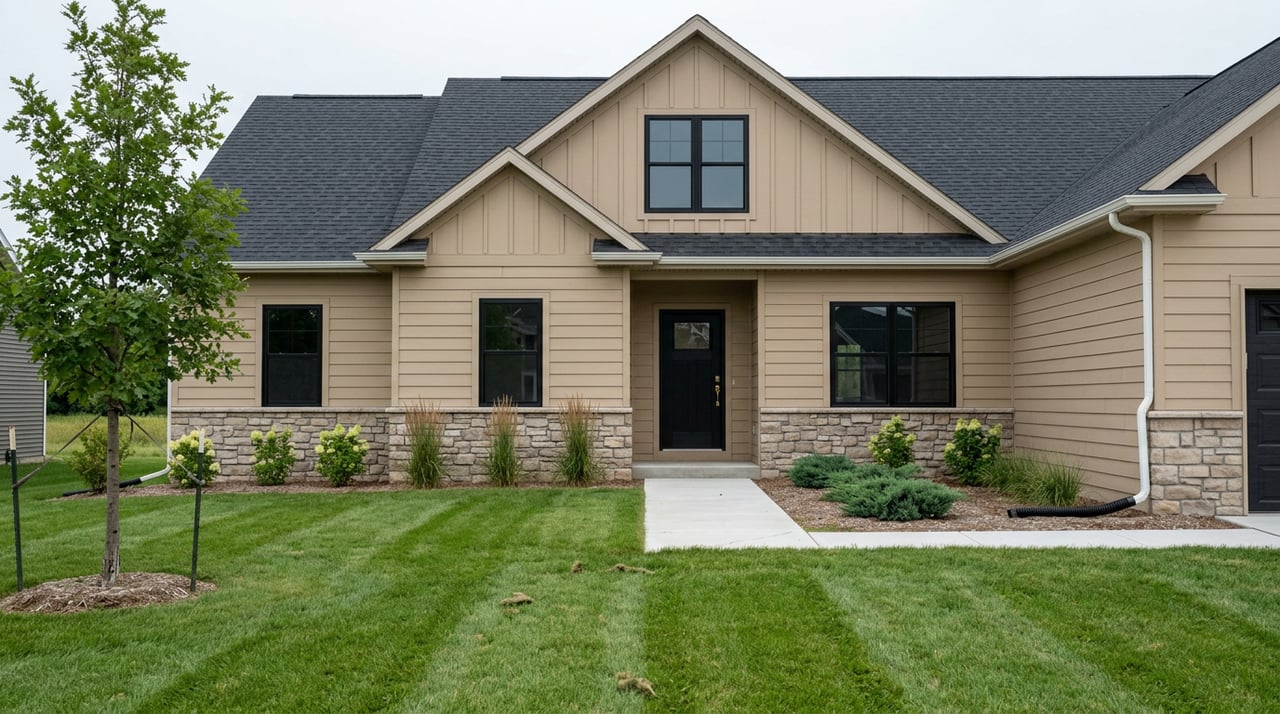
Local economic development staff have described somewhere between 600 and 800 acres currently under residential development in and around town, spanning single-family lots, multifamily, and 55-plus communities. That is not a handful of subdivisions finishing up. It is dozens of active developments, at every price tier, closing homes in the same months that the resale market is also closing homes. Mydland Estates has been pulling buyers toward homes starting in the mid-$300s. Jefferson Heights, Copper Creek Heights, and Aspen Ridge are all in active build-out. Artessa Lots is expected to deliver its first completed houses this year. Creekside, Allura, and Tiger Meadows are each contributing their own price points to the same monthly pool of closings.
When that many new homes at that many different price points close in the same reporting window, the median moves for reasons that have nothing to do with whether any individual home gained or lost value. A month heavy on entry-level new construction pulls the median down. A month heavy on premium builds pulls it up. A tracker measuring list price behaves differently than one measuring sold price, because new construction often lists at a builder's target and sells at whatever incentive got attached that month. None of that is a signal about the resale value of a home someone already owns. It is a signal about which subdivision happened to close the most sales.
This is also why phase matters more than most buyers assume. Dynamic Development is building out a 120-acre project in northeast Harrisburg in phases, and has already sold through its second phase completely. Mark Fiechtner of Dynamic Development has described the company's next phase, planned around a pond, as its highest-dollar real estate in the entire project. That is not a citywide trend. That is one builder pricing lake frontage higher than the surrounding phases, inside the same development, inside the same town, in the same year. A median that blends phase two and phase three pricing together will tell you nothing useful about what a specific lot is actually worth.
"There's not much south of 85th Street."
That is Bryce Healy, who handles economic development work for Harrisburg through the Sioux Metro Growth Alliance, describing the retail gap that still trails the town's residential growth. His read on it is straightforward: commercial development follows rooftops, not the other way around, and Harrisburg has been adding rooftops faster than it has been adding places to eat dinner.
The town's own history backs that up. Population sat at roughly 6,700 at the last census count. Within five years, the mayor was describing that figure as pushing past 11,000, and by this spring the Sioux Metro Growth Alliance put the number closer to 12,000, with a projection of 20,000 within a decade. McDonald's only opened once the town cleared the 10,000-resident mark, a threshold the mayor referenced directly when explaining why national chains finally started paying attention. Around that same stretch of growth, Union Social, a combined restaurant, bar, arcade, and bowling concept connected to the existing Air Madness entertainment center, opened its doors, its general manager crediting the town's growth for making the concept viable in Harrisburg in the first place. The city has also approved a splash pad for Central Park and new ball fields at Scheels Park, and in April 2026 the city council signed a $210,000 design contract with Co-Op Architecture for a new city hall, with construction expected to begin in late 2026 or early 2027.
None of that changes what a house is worth today. What it does change is the timeline a buyer should expect for the amenities they are picturing when they picture living there. If a listing is being marketed on the promise of nearby retail and dining that has not broken ground yet, that promise may be years out, not months. Some corridors have already made the jump. Creekside Place, a mixed development along the Willow Street and Cliff Avenue roundabout, already includes two retail strip malls running at full occupancy alongside its 229 single-family homes, 37 villas, and 47 townhomes. Other stretches of town, particularly south of 85th Street, are still almost entirely residential. Knowing which category a lot falls into tells you more about its five-year trajectory than any citywide median does.
The practical takeaway is not to distrust every number you see. It is to stop comparing a single citywide median across sources and start asking sharper questions about the specific home or lot in front of you.
A citywide median is a useful starting point for a conversation. It is not a substitute for pulling the actual closed comps on a specific street, in a specific phase, built by a specific builder.
Is Harrisburg actually appreciating right now? Closed-sales data tracked directly through the regional MLS shows a median sold price of $372,000 through June 2026, up 6.1% from the prior year. That figure reflects completed transactions rather than active listings, which is why it reads differently than list-price trackers.
Does all this new construction hurt resale values for existing homes? Not directly. New construction expands the total number of homes selling each month, which shifts the median, but it does not erase the value of an existing home unless that home is priced or positioned against buyers who would rather wait for something brand new nearby.
Should I look for lots in the newest phase of a development, or an earlier one? It depends on what you are optimizing for. Later phases sometimes carry premium features, like the pond-front lots in Dynamic Development's third phase. Earlier phases can offer a lower entry point with a longer track record of how the neighborhood has actually built out.
If you are trying to make sense of a specific Harrisburg listing, or you want someone to pull the real closed comps instead of a citywide average, Matthew Fisher Homes can walk through it with you. Get a Free Home Valuation and get a number built on your street, not a headline built on someone else's month.
Stay up to date on the latest real estate trends.
We pride ourselves in providing personalized solutions that bring our clients closer to their dream properties and enhance their long-term wealth. Contact us today to discuss all your real estate needs!